
Did AI teach Gen Alpha how to Smile?
Has a smile crossed over?
We’ve always thought of the smile as one of the most human gestures—an evolutionary shorthand for warmth, safety, even love. But in the age of animation and artificial intelligence, one wonders: is the smile still entirely ours?
Today, smiles do more than decorate faces—they can influence how we feel, learn, and connect. And increasingly, they’re showing up on non-human faces.
Cartoon Smiles: More Than Just Cute
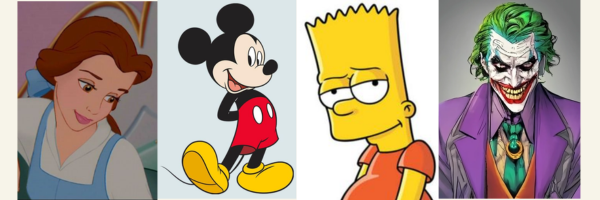
Cartoon smiles have long be under appreciated for their emotional depth. They're not just exaggerated expressions to amuse kids—they’re signals with purpose. Think about it: Belle’s shy, closed-lip smile in Beauty and the Beast teaches kindness—it invites us to engage with it. Mickey Mouse’s big grin isn’t just happy—it’s infectious optimism, wrapped up in nostalgia.
Even a character like Bart Simpson, with that signature smirk, doesn't just appear cheeky—he teaches us how to play with the rules. And the Joker’s twisted smile? We feel something in our gut when we see it—discomfort, danger, anticipation? Are inanimate smiles triggering emotions?
It’s not just projection! Neuroscience shows us that smiles activate mirror neurons in our brains, meaning we don’t just see them—we feel them. It’s a kind of emotional mimicry hardwired into us. And for kids, this mirroring effect is even stronger.
With Masked Childhoods, Human Connect got Compromised
Generation Alpha spent their earliest years behind masks—more so, around adults who were masked. This had consequences we’re only beginning to understand – a 2022 UNICEF finding noted that children aged 4–6 during the pandemic missed critical in-person socialization milestones.
Their first memories of emotional connection may have come from avatars, reaction emojis, and YouTube thumbnails. Their idea of a “genuine” smile might be a perfectly looped TikTok grin or a Roblox avatar’s exaggerated expression.
Is it then surprising that kids today often struggle to read subtle facial cues. Many of their early emotional role models probably weren’t human, rather AI generated characters.
The Rise of the Animaverse Citizen
Alpha kids were raised not just in the real world, but in what we’re calling the Animaverse. That’s the always-on world of cartoons, meme culture, AI assistants, and DIY storytelling on platforms like Roblox and Minecraft. Here, a smile is more thana show of happiness; it’s a tool. It can show kindness, signal sarcasm, or hint at deception.
If we look closely, it’s not just that Gen Alpha is growing up with AI, they're growing alongside it. We think this is more than coexistence. It’s co-evolution. These kids aren’t just adapting to AI, they’re shaping it. The relationship is synergistic, and it’s setting the stage for a future where humans and intelligent machines collaborate as co-creators, companions, and even emotional mirrors.
As AI continues to evolve, it’s likely to play an even more pivotal role not just in how Gen Alpha learns, but in how they feel. Their emotional intelligence may, in part, be scaffolded by algorithms.

Maybe this is where we start to see the seeds of a sub-cultural archetype: the Sigma “Generation”, cohabiting with their sycophantic companion.
Their smile isn’t just a reflection of how someone feels—it’s a signal, a meme, a design element, a storytelling cue. It’s been digitized, stylized, and synthesized. And if we want to connect with them—truly connect—we’ll need to speak that visual language fluently.
Because in the world they’re building, a smile might still mean happiness. But more than ever, it also means: “pay attention, I’m telling you something!”
They are breaking norms, shaking beliefs and defying structure to form a new culture code.
We think it’s time to start taking digital smiles seriously – but how?
- Design with Emotional Intelligence
Smiles aren’t one-size-fits-all. Gen Alpha seeks emotional nuance, not just friendliness—especially from AI.
- Use Expression as Language
A smirk or eyebrow raise can say more than words. Subtle expressions make content feel more real to digitally native kids.
- Teach Through Emotion
Showing vulnerability and awkwardness through expressions helps kids learn emotional cues—and builds emotional literacy.
- Rethink Digital Trust
For Gen Alpha, trust is visual. A brand’s smile can speak louder than its message—if it feels off, they’ll know.
We’re setting our sights on what might be next: Gen Alpha—“A Generational Leap”, exploring how emotional learning looks in the Animaverse world and preparing for what lies in store.
On the radar to join us on this next journey? Write to us at anshul@thatfigtree.com!
